
01 Oct Flight Simulator Time vs. Real Flight Hours: What Actually Counts Toward Your Certificate
Simulator time can shave real money and real calendar weeks off your path to a certificate, but it does not substitute for actual flight hours the way a lot of student pilots hope. The FAA caps how much sim time counts, and the cap changes depending on which certificate or rating you are working toward. Understanding those limits before you start logging hours in a box with screens will save you an uncomfortable conversation with your instructor later.
How Much Simulator Time Counts Toward Your Pilot Certificate?
For a private pilot certificate, you can typically log up to 2.5 hours of training device time toward the required 40 hours, provided the device meets FAA standards and you are training under an authorized instructor. For an instrument rating, that number jumps considerably because simulators are especially good at teaching procedures you can’t easily practice in real weather.
The exact figures depend on whether you’re training under Part 61 or Part 141, and on what kind of device you’re using. A basic aviation training device (BATD) carries different credit limits than an advanced aviation training device (AATD), and a full-motion Level D simulator used at an airline training center is a different animal entirely. None of these are interchangeable in the eyes of the regulations, so “simulator time” isn’t one single bucket. It’s several buckets with different rules attached. If you want to see exactly how a Part 141 structure handles device credit compared to Part 61, that distinction is worth understanding on its own before you plan your training block.
The Difference Between a BATD, an AATD, and a Full Motion Sim
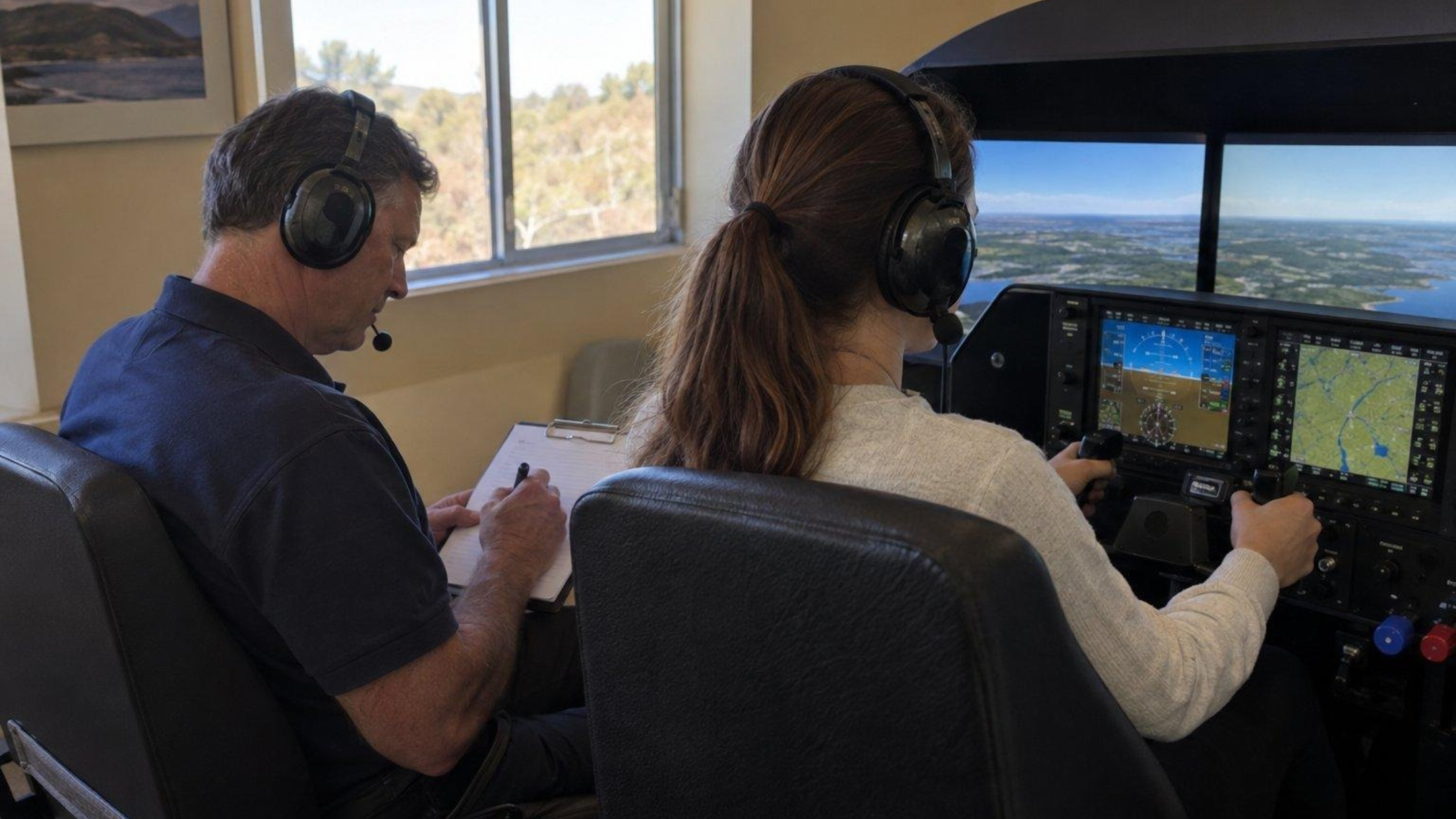
A BATD is the entry-level option, usually a desktop-style setup with basic avionics representation. An AATD is more sophisticated, often modeling a specific aircraft’s panel closely enough that transitioning between the device and the real airplane feels seamless. Full-motion simulators, the kind used for type ratings and airline training, replicate physical sensations of flight and are generally outside the scope of early certificate training at a school like ours. Know which device your school uses before assuming a number you read online applies to you.
Why Would You Want to Use a Simulator Instead of an Airplane?
Simulators let you practice high-value skills, like instrument approaches, emergency procedures, and radio communication, without burning fuel, waiting for weather, or risking a real engine-out scenario. They also let you pause mid-lesson to talk through a mistake, which you obviously can’t do at 3,000 feet.
This matters most for instrument training, where repetition of approach procedures is the whole game. A student can fly the same ILS approach several times in a simulator in the time it would take to set up and fly it once in the airplane. That repetition builds muscle memory for scan patterns and checklist flow before you add the complexity of actual aircraft handling and air traffic control on top of it.
Simulators are also far more forgiving of schedule and weather. If you’ve read about how often weather pushes back training timelines, you already know how much a flexible, weather-proof training block can help you stay on pace, and simulator sessions are one of the few parts of a syllabus that almost never get cancelled by a low ceiling.
Where Simulator Training Falls Short
A simulator cannot teach you what the airplane actually feels like: the way it settles during a flare, how the controls get heavier at higher speeds, or how your stomach reacts the first time you stall it on purpose. Examiners know this, which is exactly why the FAA limits sim credit instead of allowing someone to complete a certificate entirely on a desktop rig.
Sim time also won’t expose you to real radio traffic congestion, genuine turbulence, or the decision-making pressure of an actual go-around with other aircraft in the pattern. Students who lean too heavily on simulator hours sometimes arrive at their checkride mechanically proficient but under-practiced at handling the unpredictability of a real cockpit. A good instructor balances the two deliberately rather than treating sim hours as a way to “bank” easy time.
How Sim Time Fits Into an Instrument Rating
If you’re pursuing an instrument rating, simulator hours are where a lot of your procedural learning will happen before you ever fly an approach in actual clouds. The regulations allow a meaningfully larger share of instrument training time to come from an AATD compared to private pilot training, which is part of why instrument training can sometimes move faster than people expect once the procedures are second nature. If you haven’t already looked at what the instrument rating actually involves and why it’s worth prioritizing, it’s worth reading before you plan your simulator-to-airplane ratio.
How to Use Simulator Credit Without Slowing Yourself Down
The smartest approach is to treat the simulator as a procedures and decision-making tool, not a shortcut around flight hours. Use it to drill the things that are expensive or risky to practice in the airplane: partial panel work, holding patterns, unusual attitude recovery, checklist flow for emergencies.
Talk to your instructor early about exactly how many sim hours your program allows to count, and get that number in writing as part of your training plan. Schools structure their syllabi differently, and assuming a number from a forum post or a different school’s program is a common way students end up confused about their actual hour totals heading into a checkride.
Bottom Line
Simulator time is a genuine asset in modern flight training, not a gimmick and not a loophole. Used correctly, it tightens your procedures, saves you money on fuel and aircraft rental, and keeps your training moving when weather or schedule gets in the way. Used as a substitute for real stick-and-rudder time, it will leave gaps an examiner is trained to find. If you want a clear picture of how simulator hours fit into your specific training plan, talk to our team about your training timeline.
Frequently Asked Questions
Can you get a private pilot license using only a flight simulator?
No. The FAA requires a minimum amount of actual flight time in an airplane for a private pilot certificate, and simulator credit is capped at a small portion of the total required hours. You must complete the rest of your training and your checkride in a real aircraft.
Does simulator time count the same for Part 61 and Part 141 training?
Not exactly. Part 141 programs often have a structured syllabus that specifies simulator use at certain stages, while Part 61 training leaves more flexibility to the instructor within FAA limits. Ask your school which structure applies to your program.
What’s the difference between a BATD and an AATD for logging hours?
A BATD (basic aviation training device) generally allows less credit toward your certificate than an AATD (advanced aviation training device), which more closely replicates a specific aircraft’s systems and handling. The device’s FAA qualification level determines how much time you can log.
Is simulator time worth it if it doesn’t count toward most of my hours?
Yes, because its value isn’t only about the hours you can log. Simulator practice builds procedural accuracy and decision-making skills more efficiently and affordably than doing the same repetitions in an airplane, even when only a fraction of that time counts toward certificate minimums.
How many simulator hours count toward an instrument rating?
Instrument training generally allows a larger share of simulator or training device time than private pilot training, since procedural repetition is central to instrument flying. The exact limit depends on the device type and whether you’re training under Part 61 or Part 141, so confirm the specific figure with your flight school.
No Comments